
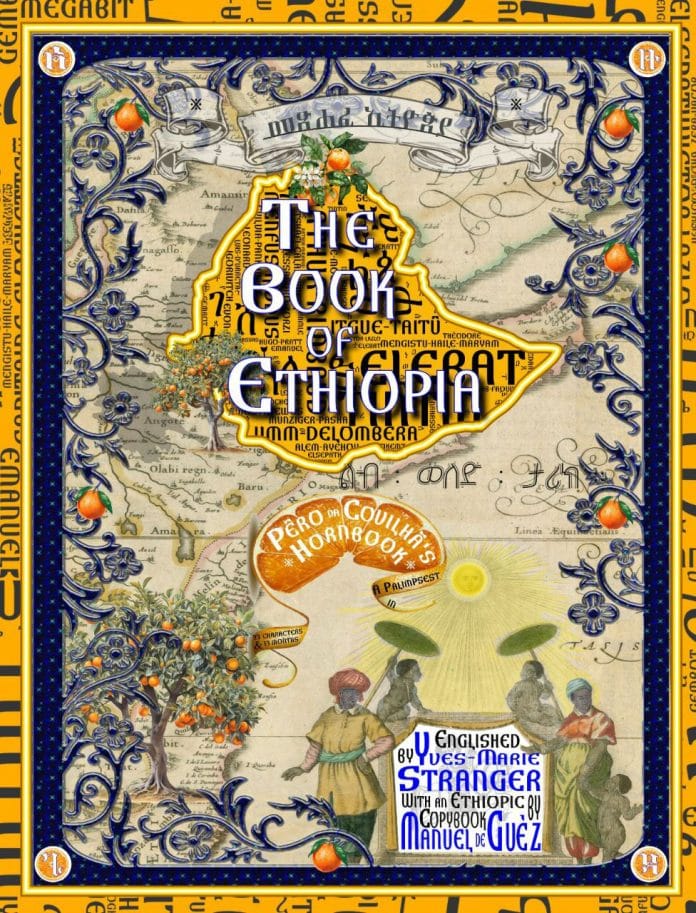
The Book of Ethiopia’, Pêro da Covilhã’s Hornbook spells out the history of Ethiopia through a series
of 33 biographical vignettes of emblematic Ethiopian lives – with each life corresponding to one of the main 33 symbols of the Abyssinian Syllabary – or Abugida.
The story begins when Yves-Marie Stranger receives an outline of Pêro da Covilhã’s Ethiopian Hornbook sent to him by Jean-Michel Cornu de Lenclos. The sketch contains the long-lost memoirs of the Portuguese traveler, an account preserved for five centuries in an Ethiopian hornbook by Pêro’s last descendant in Ethiopia, the mysterious ‘Ras Petros’.
The Hornbook includes sketches of Ethiopian historical characters, associated with numerological annotations from a forgotten work of the French anthropologist Marcel Griaule, L’Arithnomancie Ethiopienne. What ensues is a romp through the pages of Ethiopian history that will ultimately lead to an excursion to the summit of Mount Kaka, a 4,000 high peak located in the Rift Valley.
A hornbook is a primer for study made of horn affixed to a hard surface, often used for learning to read. Pêro da Covilhã’s hornbook was first used by Pêro to learn the abugida, or Ethiopian syllabary, and to transcribe the events of his life during his forty years in Ethiopia.
‘The Book of Ethiopia’ is a precious account of the great historical events of those times, and later centuries, as the Portuguese explorer’s descendants continued to use the hornbook to collect events and stories henceforth. As such, it constitutes a chronicle of five hundred years of Ethiopian history. Part historical fiction and part magic scroll, ‘The Book of Ethiopia’ compounds tentative fact and patent fiction to breathe new life into the characters of the Ethiopian palimpsest. The prologue is by the distinguished scholar Manuel de Guèz.
More [email protected]
www.youtube.com/watch?v=L2zNlpBdf0I
www.tiktok.com/@yves.marie.stranger/video/7514018637137677590