
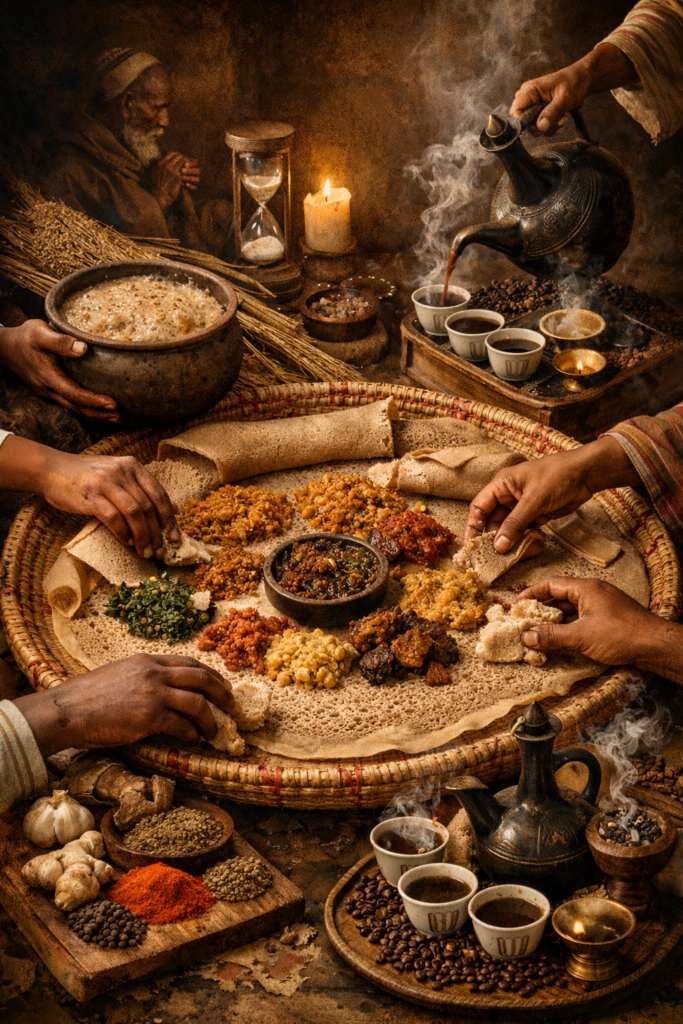
In Ethiopia, food is not just something to be eaten; it is something to be understood. Long before the word ‘nutrition’ was in use, a cuisine grew “on rhythm, restraint, and recurrence. ” The main focus of eating was not to get the most out of it, but to observe. One can ascertain balance through repetition; find meaning in structure. The core of the story is injera, fermented, porous, alive.
Teff is changed not by force but by time. The fermentation process makes the grain understandable to the body. Science only recognizes this fact at the very end. Tradition has not waited for it. Injera is not at all compatible with speed. Its whole process is found in patience.
Fasting rules the calendar. The absence makes one more perceptive; the restraint brings one back to balance. The withholding itself is just as important as the giving. Spices serve as a form of preservation. Garlic, ginger, berbere, korerima, they are medicines shrouded in the delight of the palate. Knowledge without words.
The table is dismantled in order to lessen the distance between people. Hands share a single surface. Differences in status disappear. Eating turns into closeness rather than performance.
Coffee, likewise, is a way to “slow the day.” The ceremony of coffee made the work interruption. Time is not something that is filled. It is something that is held.
This cuisine is not ancient simply because it is old. It is ancient because it knows a constant, the fact that the body is formed by rhythm, the community by closeness, and time by care. Here, food is not an expression. It is a form of order.
By Feseha Wube